

On June 19, 1865, Union General Gordon Granger rode into Galveston and read General Order No. 3 aloud. Two and a half years after the Emancipation Proclamation, the last enslaved people in the Confederacy learned they were free. Juneteenth was born in an act of truth-telling. Freedom delayed, finally spoken.
What followed was the most radical refounding the United States has ever attempted. Historian Eric Foner has called Reconstruction “America’s Second Founding” — when the Constitution itself was rewritten through the Thirteenth, Fourteenth, and Fifteenth Amendments. The Fourteenth, ratified July 9, 1868, declared that all persons born or naturalized in the United States are citizens, entitled to due process and equal protection. It was the constitutional translation of Juneteenth: a nation finally trying to mean what it had said.
The Second Founding was unfinished — sabotaged by white supremacist violence, abandoned by political compromise, gutted by judicial retrenchment. The work of repair was passed forward to Ida B. Wells, to Ella Baker, to Fannie Lou Hamer, to John Lewis, to every generation that refused to let the promise die.
It is now passed forward to us.
As the United States marks the 250th anniversary of its first founding, we face a choice. We can keep living inside the unhealed wound of racial caste — a system that has shape-shifted across centuries but never released its grip on our laws, our economies, our neighborhoods, our souls. Or we can undertake what this moment is asking of us: a Third Founding — a citizen-led, cross-racial, cross-partisan renewal of the American constitutional order, grounded in racial reckoning, in interdependence, and in the deliberative practice of democracy itself.
This is a call for that Third Founding to begin between June 19 and July 9, 2026 — a twenty-one-day mobilization from Juneteenth to the anniversary of the Fourteenth Amendment, passing through the Next250 National Mobilization on June 27, the All of U.S. mobilizations, and the 250th anniversary of the Declaration of Independence on July 4.
Name the Wound: Caste, Not Just Prejudice
Isabel Wilkerson has given us the most precise language for what we are dealing with. In Caste: The Origins of Our Discontents, she argues that the United States is not merely a society with a history of racism. It is a society organized by a caste system — a rigid hierarchy of human ranking that has shaped this nation since before its founding.
Caste, Wilkerson writes, “is not about feelings or morality. It is about power — which groups have it and which do not.” She identifies eight pillars — divine justification, heritability, endogamy, purity, occupational hierarchy, dehumanization, terror, and the doctrine of inherent superiority — and documents how the architects of Nazi Germany studied Jim Crow as a model.
Naming the wound as caste matters. Prejudice is something individuals carry. Caste is something a society builds. Healing prejudice asks for personal change. Healing caste asks for constitutional change — a refounding of the rules that govern who has voice, who is policed, who is protected, and who is treated as fully human.
Wilkerson points toward moving “beyond the artificial and destructive separations of human divisions, toward hope in our common humanity.” The Third Founding is the political project of doing exactly that.
The Working Majority That Was Never Allowed to Form
If Wilkerson names the wound, Heather McGhee names the trap. In The Sum of Us, she argues that racism has costs that fall on everyone — including white working-class Americans — and that the durable obstacle to a thriving multiracial democracy is the zero-sum lie that progress for Black, Brown, and Indigenous Americans must come at the expense of white Americans.
Her signature metaphor is the drained pool. In the mid-twentieth century, American towns built grand public swimming pools — civic palaces, open to all white residents. When courts ordered integration, white officials chose to drain the pools and fill them with concrete rather than share them. Everyone lost. That, McGhee shows, is the story of public goods in America: schools defunded, healthcare blocked, unions broken, wages stagnated — because a white majority was persuaded that sharing meant losing.
But where Americans of all races have linked arms across the lines designed to divide them, McGhee finds the Solidarity Dividend: real, measurable gains that come only through cross-racial collective action.
Here is the truth McGhee makes inescapable: the working class of this country — Black, white, Latino, Asian, Indigenous — is the majority. And it has been intentionally divided. The two-party system does not represent that working majority. It manages the split in it — harvesting grievances, sorting them by race and culture, converting them into coalitions that protect concentrated wealth at the top.
Independents are now the largest political bloc in America — a sign that tens of millions already sense the trap. The Third Founding is the work of building, at last, the cross-racial, cross-partisan working majority kept from forming for 250 years.
What MAGA and Project 2025 Are Actually Doing
We must be plain about what we are up against. The far-right movement that calls itself MAGA, and the governing blueprint known as Project 2025, are an overtly racial project — a coordinated effort to dismantle the legal architecture of the Second Founding and re-establish a Jim Crow framework for the twenty-first century.
The Leadership Conference on Civil and Human Rights has documented how Project 2025 would gut the DOJ’s Civil Rights Division, end federal collection of employment data by race, and weaponize civil rights laws against diversity, equity, and inclusion. The NAACP Legal Defense Fund has spelled out how its proposals would deprive Black people of the citizenship and equal protection guaranteed by the Reconstruction Amendments. Congressman James Clyburn has named it bluntly: Project 2025 is Jim Crow 2.0. And the same movement is now actively challenging birthright citizenship itself.
This is not a culture war. This is a constitutional war on the Second Founding — an attempt to whitewash American history so an unequal future can be imposed without remembered resistance. The All of U.S. coalition has named the choice precisely: a choice between erasure and equality.
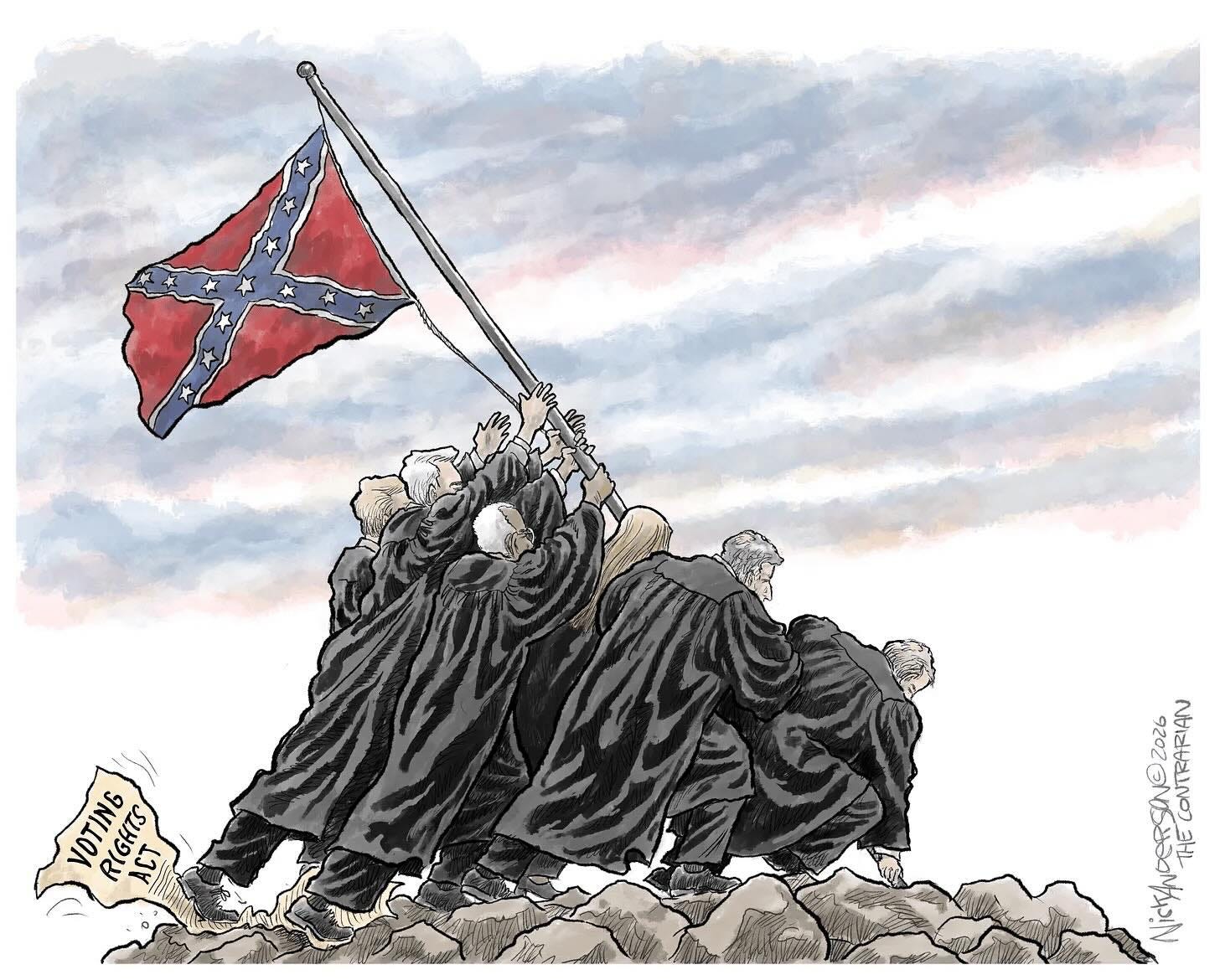
We will not let this happen. Not the stripping of birthright citizenship from American children. Not the hollowing of the Voting Rights Act. Not the reduction of the Fourteenth Amendment to a museum piece. Not the erasure of our full history — the parts that indict us and the parts that ennoble us. This is necessary with know methods of healing, such as radical reparations and truth-telling.
A Call to Centrists, Independents, and Principled Republicans
This is where the call must be widened.
To centrists: a nation cannot remain stable on top of an unhealed caste wound. The rule of law, equal protection, and the orderly succession of power are not partisan goods — they are the preconditions of every other good. Defending the Fourteenth Amendment is the most conserving act available to anyone who loves what is most worth keeping in this country.
To Independents: you already feel the manufactured polarization that turns neighbors into strangers and citizens into spectators. The Third Founding is built for you. It is a citizen-led, deliberative process that does not require you to belong to either party. It requires only that you belong to the country.
To principled Republicans: your party was founded in 1854 as the anti-slavery party. It carried the Civil War. It wrote the Reconstruction Amendments. Frederick Douglass was a Republican. The tradition of Lincoln — of dignity, natural rights, and equal protection — is not the same as the movement that has captured the party today. To stand against the racialized authoritarianism of Project 2025 is not to leave conservatism. It is to reclaim it.
None of us can do this work alone. None of us should.
21 Days of Action: Juneteenth - July 9, 2026
Between June 19 and July 9, 2026, we can weave together what has been kept apart: racial reckoning and constitutional renewal, Black democratic tradition and cross-partisan coalition, protest and proposal, grief and imagination. This is a movement of movements — a convergence that no single organization owns and no single ideology controls.
June 19 — Juneteenth: The Second Founding. We begin where Reconstruction began — with the truth of emancipation, finally spoken. Communities across the country gather to honor the Black democratic tradition that has carried this nation closer to its ideals than any other force in our history. From Frederick Douglass to Ella Baker, from Fannie Lou Hamer’s testimony at the 1964 Democratic Convention to John Lewis crossing the Edmund Pettus Bridge — we must now declare that we are the generation called to take up their unfinished work.
June 25–28 — Braver Angels 2026 National Convention, Philadelphia. Under the theme 1776 to 2026: A Pledge Renewed, Braver Angels convenes on hallowed ground in Philadelphia to practice the cross-partisan courageous citizenship the Third Founding requires. Red and blue, conservative and progressive, religious and secular — together for four days of building the trust without which democracy cannot endure. As the Declaration of Independence reminds us, the founders did not only declare independence from a king; they pledged themselves to one another. That mutual pledge is what we are renewing today.
June 27 — Next250 National Mobilization, Washington, D.C. Next250 convenes under the banner of the Declaration of Interdependence which names the truth that no community in America thrives alone — and commits to a Living Wage, Climate Justice, Reproductive Rights, Voting Rights, and Gun Safety and Peace for All. It is the moral companion to the People’s Bill of Rights 250 — a citizen-led deliberative process asking: What rights does this moment demand? Interdependence is the spirit. The People’s Bill of Rights are the Constitutional amendments being harnessed from the wisdom of the people!
June 27 — All of U.S. Mobilization. The All of U.S. coalition is organizing a nationwide mobilization for Truth, Equality, and Freedom. We repair our full history rather than erase it, celebrate the progress won through struggle, and commit to liberty and equality for All of U.S. Find or host a mobilization.
July 4 — The 250th Anniversary. Not a day for triumphalism, rather a day for honest reckoning — for asking what we have made of the founding promise, for grieving where we have fallen short, for recommitting to the unfinished work. The First Founding gave us the language of equality. The Second Founding tried to make it real. The Third Founding is the work before us in these days of finally completing what those before us began.
July 9 — The Anniversary of the Fourteenth Amendment. We close where the Second Founding constitutionally crystallized. The Center for Popular Democracy has launched a campaign to protect the Fourteenth Amendment, and PolicyLink reminds us that it was never a static historical marker but a living tool — a shield against harm and a command that government deliver fairness and justice. On this day, we recommit — across race, across party, across region — to defend its promise of equal protection, due process, and birthright citizenship for every person within our borders.
The Lineage We Inherit
I think often about what it means to inherit unfinished work. Every generation before us carried this nation a little closer to the promise it has never fully kept. Now the work is ours.
This is a lineage of love — not sentimental love, but the demanding kind. The kind that refuses to settle for a country less whole than its people. The kind that insists, against every evidence of cruelty, that we belong to one another.
I believe we are ready. I believe the cross-racial, cross-partisan working majority that has been kept from forming for 250 years is finally ready to form. I believe the Third Founding is not a fantasy — it is emerging and we each have a practice that begins the moment enough of us decide this is happening, and it is possible.
Between Juneteenth and July 9, 2026, let us take action together.
Dr. Paul Zeitz is a preventive medicine physician, epidemiologist, ordained Song of Songs Rabbi, founder of #unifyUSA, and co-initiator of the Renew American Democracy (RAD) movements, a new catalyzing platform. He is the author of Hit Refresh on the U.S. Constitution and Revolutionary Optimism: Seven Steps for Living as a Love-Centered Activist. He delivered the TEDxPrinceton talk “Peacecrafting: From Conflict to Collaboration” in February 2026.