

Something shifted in Iowa this winter. Not the weather — though it was bitterly cold — but something in the air of civic life that I haven’t felt in a long time. Something that felt, honestly, like hope with teeth.
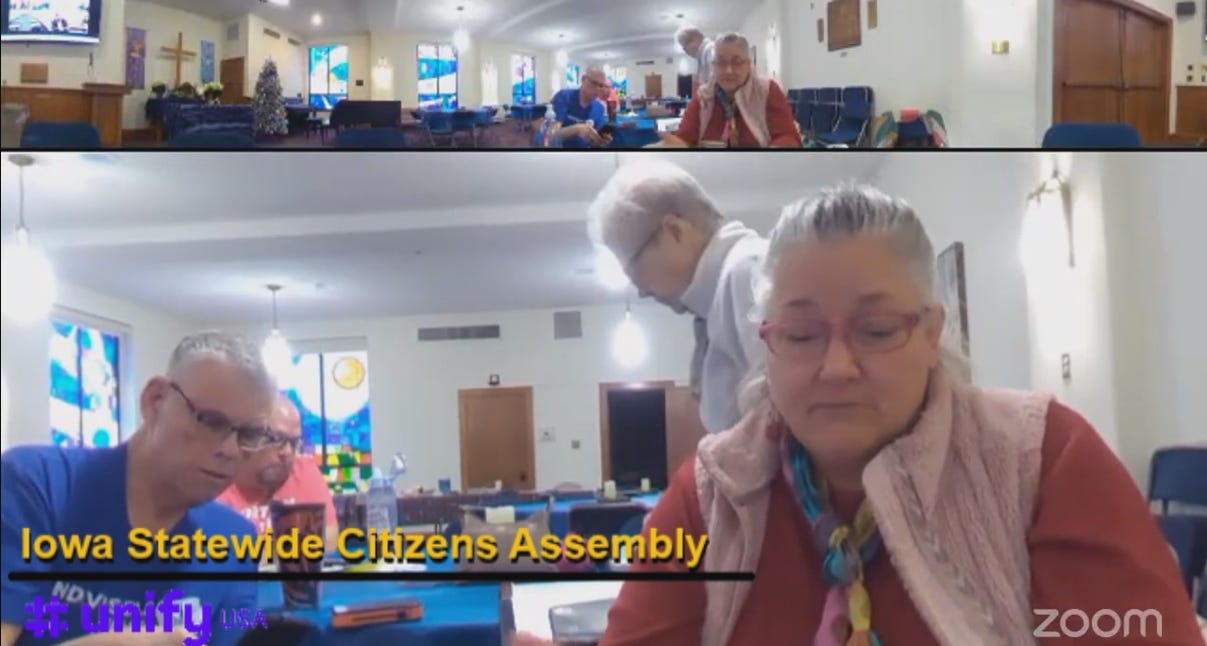
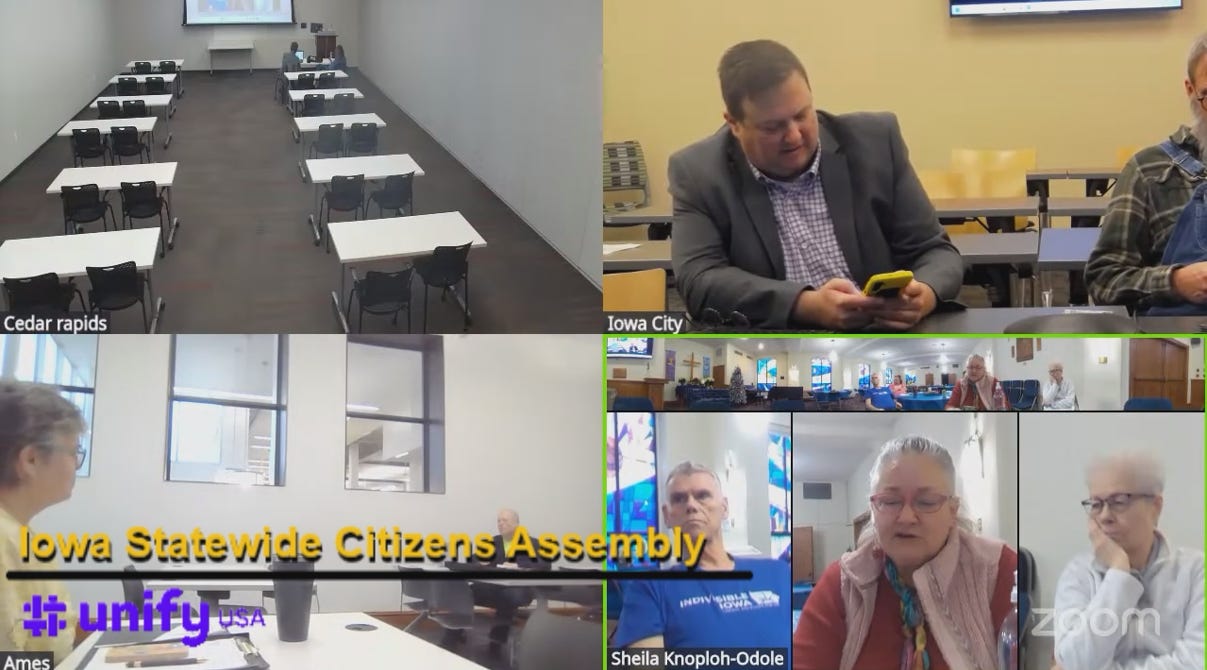
In four cities simultaneously — Iowa City, Cedar Rapids, Ames, and Des Moines — ordinary Iowans gathered in public libraries and a church, connected across distance by video screens and something harder to quantify: a shared refusal to accept that our democracy is simply broken beyond repair.
Over two weekends in December 2025 and January 2026, they generated more than 50 serious constitutional amendment proposals. No shouting. No trolling. No billionaires pulling strings backstage. Just citizens doing what citizens were always meant to do — governing themselves.
I know what movements look like when they’re just getting started. Iowa feels like that.
Declaration of Constitutional Obsolescence
The Iowans didn’t mince words. They adopted the Declaration of Constitutional Obsolescence, which names the problem directly: our Constitution — brilliant as it was for 1787 — was not built for the world we’re living in now. Rigged elections, corporate capture of our political system, the erosion of voting rights, a Supreme Court with no term limits and no meaningful accountability. These aren’t partisan talking points. They are structural failures that citizens across the political spectrum can see with their own eyes.
What moved me wasn’t just the diagnosis. Any of us can diagnose. What moved me was the prescription — the willingness to sit with one another, across differences, and actually craft solutions. That’s rare. That’s precious. And that’s exactly what happened.
Democracy Without the Poison
Cross-partisan Iowans gathered on back-to-back Saturdays to propose and debate constitutional amendments. Healthcare as a right. Climate protections written into the foundation of law. Limits on money in politics. Term limits for the courts. Structural safeguards against the concentration of power.
What struck observers — including the many legal professionals who participated — was not the radicalism of these ideas.
It was the civility.
The absence of what we’ve come to expect from American political life. When you remove the performance incentives — the social media algorithms, the partisan scorekeeping, the cameras angled for outrage — what you find underneath is something quite beautiful: people who actually want things to work.
I call this peacecrafting. Transforming conflict into collaboration. It doesn’t require us to agree on everything. It requires us to agree that we are in this together — that interdependence is not a liberal or conservative value, it is simply the truth of how human beings survive and flourish.
How It Actually Worked
Here’s what I love most about the Iowa model: it’s almost embarrassingly simple. When I spoke with the lead organizer about how they pulled it off, his reaction to his own checklist said it all: “When I wrote it down, I was like — really? This is it? This is all we have to do?”
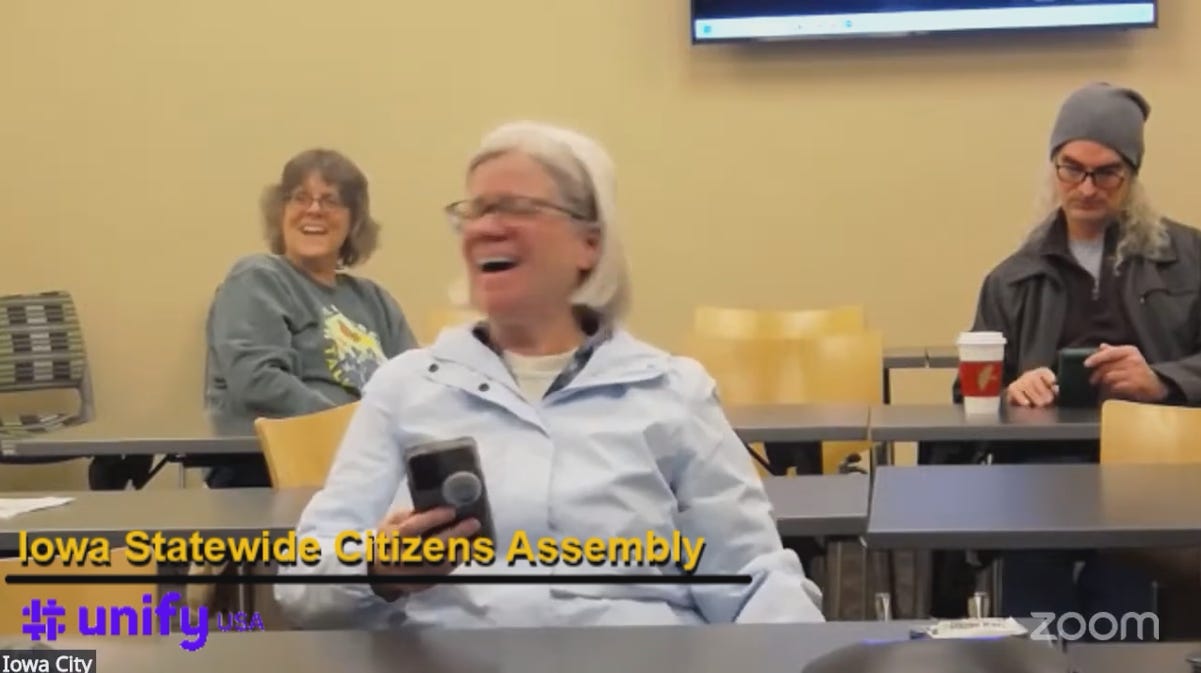
The sessions ran 1–5 p.m. on consecutive Saturdays in public library meeting rooms — spaces that already come equipped with technology and, crucially, a staff technician whose job is to make sure everything runs. The organizers didn’t touch the AV setup. The library handled it. Total cost: nearly zero.
The structural key — the insight that made everything work — was deceptively simple: rotate city to city, not topic to topic. Each participant got three minutes to present a proposal. After each one, the floor moved to the next city. No rebuttals. No live debate. Discussion and voting happened asynchronously on the proposal platform, meaning everyone got a voice without anyone having to wait or shout.
“I told them at the beginning — most people here want to speak, and we’re going to give everyone a chance,” the organizer explained. “Arguments happen online. The only people speaking out loud are the people making proposals.”
What happened next still amazes me. Nobody went over three minutes. When a proposal landed well, the room simply nodded and moved on. “There was never any point where people were just talking and talking,” the organizer said. “At the end, they’d stop speaking and everybody would just be nodding — yeah, that was a good one — and we’d move on.”
They had planned for 42 proposals over four hours. They completed 55 in three — and adjourned early.
The genius of the Iowa model is also what it isn’t. It isn’t expensive — libraries provide the rooms for free, and free streaming tools connect the cities. It isn’t complicated. And it isn’t vulnerable to disruption. When civic engagement happens in a library — on video, in public, in an undeniably peaceful and legitimate setting — there is no pretext for interference. As the organizer put it: “They can’t go into libraries and start busting heads. It’s organized. It’s peaceful. It’s all on video. They would stick out like a sore thumb.”
This is strategic nonviolence for the digital age. Not passive. Not naïve. Tactically smart.
ACTION OPPORTUNITY: You can add your ideas and vote on other ideas through a simple registration process here: https://ypus.org/community/389
Iowa Is First. Iowa Won’t Be Last.
“The People’s Refresh” is our national initiative, and Iowa has the honor of lighting the first match. But this was never just about Iowa. Participants weren’t trying to convince the people in the room — they were making a case to the American people. Every proposal generated in Cedar Rapids and Des Moines becomes raw material for the next state. And the next.
We are building, methodically and joyfully, a people-powered constitutional renewal movement — one that will crescendo as America approaches its 250th birthday in 2026.
The Founders wrote their version of the Constitution. They did the best they could with what they knew and who they were — and we owe them genuine gratitude for that. They also built in a mechanism for revision precisely because they were humble enough to know they wouldn’t get everything right. Article V, the amendment process. Article VII, the ratification process. These aren’t loopholes. They are invitations.
Now it’s our turn to accept the invitation.
The Challenge
I want to close with a direct ask — because in my experience, movements die from vagueness, not from specificity.
If you are a citizen exhausted by the daily indignities of a political system that no longer serves you — join us. If you are an organizer, a faith leader, a doctor, a teacher, a veteran who has given deeply to this country and wants to give once more — we need you to bring this to your state.
Host a free assembly at your local library. Convene your neighbors. Name the problems. Propose the solutions. Trust the process.
The Iowa organizer said something near the end of our conversation that I keep returning to: “Once we did the first proposal, everybody figured it out and we were just rolling. It’s free. It’s peaceful. It’s in a library. There is just no reason not to do this.”
We are not waiting for permission. We are not waiting for the right politician to save us. We are — finally, joyfully, urgently — saving ourselves. It is time for all Americans to realize their own authority.
Revolutionary optimism is not naïveté. It is the disciplined choice to act as if transformation is possible, until it is.
Iowa proved it’s possible. Now let’s prove it everywhere.
Dr. Paul Zeitz is co-founder of #unifyUSA and author of “Hit Refresh on the U.S. Constitution.” Learn more at unifyUSA.org
I like that, Paul, “Revolutionary optimism is not naïveté. It is the disciplined choice to act as if transformation is possible, until it is.”
Optimism is a discipline. It involves daily practices, deliberate language, and courageous action that align belief with behaviour. It asks us to show up consistently, to ask better questions, to invest in people and possibilities, and to take the next constructive step even when outcomes are uncertain.
Well done and well said. Informs and inspires