

I need to tell you the truth, and the truth has two faces.
The first face is hard to look at, and I refuse to look away. We are approaching an existential moment in our Nation’s history. The authoritarian regime playbook is no secret — it has run in country after country, and its sequence is now aimed at us: hijack free and fair midterm elections, sow doubt about the results, manufacture a contested election, and then attempt to cross the redlines that would seize control of our system of government itself. This is not paranoia. This is pattern recognition.
The research on democratic collapse around the world delivers a warning that should keep every one of us awake: the critical juncture is not three years away, not someday — its opening moves may arrive with the very elections in front of us. And history’s verdict on such moments is merciless: movements that are not ready when the window opens get swept aside by better-organized counter-movements. History does not grade on effort.
And beneath the immediate threat sits the deeper truth: our democratic system was breaking down before any tyrannical regime playbook touched it — not in one place, in many places at once. What we are living is what the system, as currently designed, produces. Beneath every symptom you can name — the paralysis, the corruption, the contempt, the whiplash of each party undoing the last — sits a missing national consensus about who we are and what government is for. The playbook does not create the vulnerability. It exploits it. Which means defense alone will never be enough.
The second face of the truth is the one I witnessed on Thursday, September 17, 2026 — Constitution and Citizenship Day — and it is why my hope trembles as I write this. Not with fear. With recognition.
The Fourth Founding is more than underway. It is becoming vivid — vivid to the pillars of our society. Policy institutions. Constitutional scholars. State legislators and the leaders who renovate state democracies. Faith communities and bridge-builders. Funders. The organizers of independents who belong to no party. Ordinary citizens sitting in assemblies in Nevada, New Hampshire, and South Carolina. Across every one of these pillars, the same understanding is taking hold at the same time: that this moment demands not restoration of a broken status quo, rather transformation of the system itself — and that the people must author it. That shared recognition, arriving simultaneously across so many sectors, is what acceleration looks like. I have spent decades in movements. I know the feel of a field when it tips. It is tipping.
On that day, the Renew American Democracy Strategy Forum did something our fractured pro-democracy field has almost never done: we put the architects of systems transformation and the practitioners of deliberative democracy in the same room, on the same question, at the same time. And instead of competing for the title of “the answer,” we saw the pathways for what they truly are — complementary vehicles, operating at different levels and different time horizons, converging on one destination.
That destination has a name. The Fourth Founding. And here is what the Forum made undeniable: it is not one transformation. It is three — political, economic, and social — moving through this country at once, bound together by a single method that makes change legitimate rather than imposed: deliberation, by the people themselves.
The Race Between Two Futures
Hold both faces of the truth together and you see the moment whole: two futures are accelerating toward the same window, and only one of them can arrive first in force.
In one future, the authoritarian playbook completes its sequence — doubt sown, election contested, redlines crossed — and the incentives and mechanisms that produced this crisis are locked in place, harder than ever to dislodge. In the other, a prepared, connected, cross-partisan supermajority of Americans meets that moment with something the playbook has no answer for: legitimate public authority, organized in advance, spanning the pillars of society, carrying the authored will of the people.
This is why the RAD Plan is built on the ecology of Block, Bridge, Belong, and Build — with Power at the center. Blocking the authoritarian advance is essential and it is not sufficient. Defense and construction are different functions, and the field’s job is to connect them rather than force every actor to do both. The Emergency Scenario Planning framework exists precisely because nobody knows which political future arrives — which is why the Forum’s central strategic insight matters so much: what we need are engines of readiness, capacities that pay off across every scenario. If the redlines hold, the architecture we build now delivers transformation through the 2028 cycle. If the redlines are crossed, that same architecture — the relationships, the deliberative infrastructure, the cross-partisan legitimacy — becomes the organized democratic majority that refuses the outcome. Readiness is not one strategy among many. Readiness is the whole game.
So we choose readiness. And we choose it now, because the volatile period from this November through January is precisely when the trust we build in advance becomes usable — or is proven never to have existed.
Three Transformations, One Founding
The participants in that room refused to let “democracy reform” stay confined to political machinery. Again and again, the conversation broke the banks of process and procedure and flooded into the terrain where Americans actually live. What emerged was a picture of the Fourth Founding whole: three domains of systems transformation, each incomplete without the others, each requiring the credible voice of the people to become real.
Political Systems Transformation: Changing the Incentives Themselves
The Forum opened from the Democracy Assessment of the U.S., and I will not soften what it shows. Multiple parts of our democratic ecosystem are failing simultaneously. The toxic tug-of-war in which each party spends its power undoing the last is not a mood we can vote our way out of — it is the predictable output of incentives baked into the structure itself. The remedy is structural: changing those incentives. And structural change demands something no organization, no funder, no charismatic leader can conjure alone — a cross-partisan civic and political supermajority.
Three political vehicles were presented, and here is what made the session historic: they were treated as layered rather than rival. Issue One‘s core legislative reform agenda — the American Anti-Corruption Act, the Checks and Balances Act, and the Information for America Act — offers bold, visible momentum in the first years out of the gate, including the restoration of Congress’s Article I authority that an authoritarian executive most fears. Partners in Democracy‘s state renovation work rebuilds democratic health where people actually live, and bridges it to federal reform. And the Article V safeguard strategy opens the constitutional pathway itself while shielding it from hostile capture. The governing wisdom of the panel: do not put the pathways in competition. Layer them by time scale and by level of government.
Economic Systems Transformation: The Kitchen-Table Bridge
Then came the question our field has been avoiding, and I am grateful someone pressed it: how far are we from deliberative processes that can hold multiple interconnected issues and their real budgetary trade-offs — housing affordability against healthcare costs against homelessness against education? Because that is where Americans live. Not in a single-issue silo. In the crosscurrents. And that is precisely the terrain where authoritarianism recruits — among people whose material struggles have been abandoned by a system that stopped answering them.
The answer from the Thriving Together and Vital Conditions tradition landed like a revelation: hundreds of communities are already working multi-solver. Washington State’s decade-long poverty initiative has been running community assemblies with people of lived experience for eight or nine years. This is not theory. This is practice, quietly proven, waiting to be connected.
The strategic stake was named without flinching: democracy renewal loses its public meaning the moment it is detached from what people actually experience — housing, water, health, education, economic security. The sequencing must embody the answer. Start with the tangible issues people feel in their bodies and their budgets, and let the governance questions surface inside them. That is precisely what happened in Nevada, where a citizens’ assembly on water scarcity became, organically, a conversation about democratizing water decision-making itself — transparency, participation, accountability for the common good. The kitchen table is the bridge. The kitchen table has always been the bridge.
Then came the most expansive vision spoken in that room, and my hope trembled when I heard it: if a constitutional moment arrives, and each state brings its own most urgent issue to that table — water, housing, rights, land — that very complexity could open the door to something America has never had. Social and economic rights in the Constitution, alongside civil and political rights. Thriving-together language — governing-for-all language — in a revised preamble. The Fourth Founding, written whole.
Social Systems Transformation: Legitimacy, Trust, and Public Authorship
The third transformation is the deepest, because it is the one the other two depend on — and the one the authoritarian playbook attacks first. The playbook’s opening move is always the same: sow doubt, corrode trust, convince citizens that no election, no institution, no neighbor can be believed. The antidote is not better messaging. The antidote is rebuilding the social fabric of legitimacy itself.
The question that organized the rest of the session was this: how do we make this not a top-down effort — how do we reach the disaffected, rather than self-selecting for people already fluent in civics? The operational answer already exists in the field: power-building grounded in deliberation and the credible voice of the people, with a 70 percent minimum consensus threshold and citizen champions carrying recommendations into legislatures with their own hands. Legitimacy is not a garnish on this work. Legitimacy is the work — because our institutions need decisions that are both effective and carry durable public authority, and only genuine public authorship produces both. A people who have authored their own agenda cannot be told their voice was fraudulent.
One language intervention from the session deserves to travel far beyond that room: the word “partisan” — even inside “cross-partisan” — negates the millions of Americans who claim no party, and can seed the very mistrust deliberation exists to repair. Independents are not a rounding error in this founding. They are co-authors. Our framing must include them rather than define them out.
The Highest-Leverage Move: A Nationwide Deliberation Campaign
Across all three transformations, one opportunity rose above the rest: the Nationwide Deliberation Campaign (NDC) — not because it belongs to RAD, rather because it is the one piece of architecture every pathway needs and none can build alone.
Listen to the demand signals that surfaced in a single afternoon. Issue One’s legislative package needs public co-shaping, not a top-down drop. The Article V safeguard strategy is legally and politically dependent on credible citizens’ assemblies existing at scale. State renovators are building the connective tissue between state and federal agendas. Every one of these is crying out, in its own language, for the same thing: a legitimate way for the American people themselves to author what comes next.
The NDC answers with four layers of public engagement: grassroots and local deliberation with mutual-aid on-ramps; online deliberation at national scale, including People’s Bill of Rights 250; rigorous deliberative polling with leading academic partners; and civic and citizens’ assemblies at the state and national level. The aim is audacious and it is achievable: a People’s Proposal carrying cross-partisan supermajority legitimacy by late 2027 or early 2028. The governing principle is non-negotiable: AI assists, citizens decide.
Understand what this really is. The NDC is not merely a campaign — it is readiness infrastructure, the civic immune system a nation needs when the playbook comes for it. We are not predicting the future. We are preparing for all of them.
Four Weaves: Where Separate Threads Become a Rope
Four concrete weaving opportunities emerged — places where efforts that grew up apart can now be braided into something none could be alone.
Weave 1 — The 13-state strategy meets federal–state alignment. The Article V safeguard strategy carries an elegant, urgent logic. Thirteen states pass identical resolutions preemptively rejecting any constitutional amendment proposed by a convention that is not democratically accountable — the gold standard being delegates bound by citizens’ assemblies. Because thirteen states are exactly what it takes to defeat ratification, a hijacked convention’s output is rendered stillborn before it draws breath. This is offensive defense: it shields the Constitution from a hostile takeover while opening the only plausible path to amendment, given that no foreseeable Congress will produce a two-thirds proposal. The Common Purpose Council — convening state and federal reformers around fighting corruption and effective representation — could supply the distributed movement through which thirteen resolutions actually pass. The first working conversations begin at the VthePeople conference at Harvard Law School, October 2–3.
Weave 2 — A democracy scorecard as a public ecosystem asset. In Massachusetts, a holistic scorecard of the state’s democratic health performed a quiet miracle: it invited organizations laboring on single reforms — ranked choice voting, open primaries, campaign finance, civic education — to see themselves as one democracy-first coalition, producing an organic slate of three democracy ballot initiatives bound by a single narrative. Imagine that power extended to all fifty states: a shared, field-accessible map showing relationships, readiness, gaps and leverage. Fragmentation is the tax our field has paid for decades — a tax we cannot afford in the year ahead. This is how we stop paying it.
Weave 3 — Scaling proven state assemblies to national scale. The Forum has already run the proof: thousands of residents per state voting on priority issues; deliberation moving from problems to solution pathways; a lottery-selected, fully representative assembly forging recommendations at a 70-percent-plus consensus threshold; citizen champions carrying those recommendations into legislatures as draft bipartisan legislation. Nevada deliberated water. New Hampshire took on housing. South Carolina followed. I will be honest about the cost, because facing the truth includes facing the price tag: a serious national process, with the media strategy it demands, lands in the $50–100 million range. Hear me clearly — the money exists in this country. What has been missing is the case, made together, for political legitimacy purchased at a serious price. That case is now being built. Alongside this, Hope for Democracy is catalyzing state citizens’ assemblies in 21 states, and CADA is stewarding the national community of practice tracking the deliberative wave.
Weave 4 — Legislation as clay, not stone. Issue One brought its three bills to the Forum with a framing that marks a genuine institutional turning: the package is “clay, not etched in stone,” and deliberative co-shaping is now formally part of the strategy. Read that again. A national policy organization has committed to letting citizen judgment actually change the text. That is what the Fourth Founding looks like when it moves through a pillar institution — vivid, and accelerating.
Many more weaves are possible and anticipated in the days ahead!
The Timeline: From This Month to the Window
This is the working proposition that came out of the Forum — not a commitment by any single organization, rather a map of the handoffs that make each convening cumulative instead of an isolated spike. Read it against the threat: every milestone below lands either just before, during, or just after the period when the playbook would make its moves. That is not coincidence. That is design.
September 23–25, 2026 — Independent National Convention, Washington, DC. Deliberation woven into the program of the largest gathering of American independents; the “Renewing Congress / Independent Fulcrum Caucus” roundtable report released on site. (RAD · Independent Voice · AllSides)
October 2–3, 2026 — VthePeople, Harvard Law School. Supporters and skeptics of Article V convene together; the 13-state democratic-accountability strategy is tested in the room, with a session on citizens’-assembly structures alongside international practitioners. (VthePeople · RAD delegation)
Week of November 16, 2026 — “What Comes Next?” national AllSides Roundtables. Post-election public deliberation carrying the Fourth Founding themes into the most volatile window of the cycle — a public on-ramp and kick-off runway for the NDC, convened whatever the election delivers. (RAD · AllSides · Renew to Thrive)
December 2026 — NANR annual gathering. A connected convening, and a candidate venue for the first cohesion-organizing conversation about the 2028 convergence. (Renew to Thrive / RAD convening team)
January 2027 — The Nationwide Deliberation Campaign officially launches. Steering committee stood up, coalition charter and partner MOUs executed, four-layer architecture into the field. (NDC team · anchor partners)
Through 2027 — Deliberation at scale. State citizens’ assemblies expanding beyond Nevada, New Hampshire and South Carolina; national online deliberation through PBOR250; the deliberative polling layer; the 13-state resolution campaign entering state legislatures. (The Forum · PBOR250 · NDC · state partners)
Q1 2028 — A possible first National Citizens’ Assembly & National People’s Convention: the convergence. Aligned efforts converge to adopt a platform and agenda for systems transformation carrying cross-partisan supermajority legitimacy. (The full cohesion-organizing table)
2028 cycle — Meeting the Moment. The People’s Proposal enters the political and election cycle as a public mandate, not an expert package. (All partners)
2029 window — The structural reform window of opportunity. The legislative core package, the constitutional vehicles, and the publicly authored mandate arrive at the window together rather than separately. (All partners)
Two tempo notes, and I ask you to feel their weight. The volatile November-to-January period is precisely when the relationships and trust we build now become usable — when doubt is being sown, when an election may be contested, when redlines may be tested, the difference between a connected field and a fragmented one is the difference between resistance and rout. And if the convergence is twelve to eighteen months out, the planning cannot wait. That is why this report exists. That is why this post exists.
The Convergence Must Be a Table, Not a Stage
The Forum’s closing discussion turned to the convergence itself — a people’s convention, a people’s assembly, or both, in late 2027 or the first quarter of 2028. Multiple groups are circling this same idea independently, which tells you something is stirring in the deep waters of this country. That independent circling is itself the acceleration made visible: pillar after pillar arriving at the same conclusion without being told.
The proposal on the table is cohesion organizing: not a new umbrella organization, not a merger — bringing these efforts into living relationship so they can see each other, sequence their work, and converge by choice. And here is the design question we stated out loud, because facing the truth means facing this too: the convergence must be a genuine table rather than a stage. If organizations arrive merely to ratify a proposal written elsewhere, the legitimacy this entire architecture exists to create is forfeited at the final step — and legitimacy is the one weapon the authoritarian playbook cannot counterfeit. The People’s Proposal must actually be the people’s. That is why the convening conversation starts now, and starts shared.
Why My Hope Trembles — and Holds
One reflection from the Forum has stayed with me. Most democracy convenings are about the what — which reform, which model, whose answer wins. This one was about the how — the processes, relationships, sequencing and adaptation through which many solutions become consequential together. Connecting the dots will not produce a straight line. It will be a curvy one. That is not disorder. That is adaptive navigation. That is how every founding in our history has actually moved.
And here is the measure of how far we have already come: not long ago, state-level citizens’ assemblies were an idea that got calls unreturned. Several have now been held. More are planned. The conversation has moved to what comes after them. The deliberative wave has reached American shores. The path to a Fourth Founding runs directly through it.
So yes — my hope trembles. It trembles because I can see both futures from where we stand: the playbook completing its sequence, or the people completing theirs. It trembles the way a hand trembles when it reaches for something that matters. And it holds, because the Fourth Founding is no longer a vision held by a few. It is vivid to the pillars of society. It is accelerating. Political transformation, economic transformation, and social transformation are converging into one founding, authored by the people themselves.
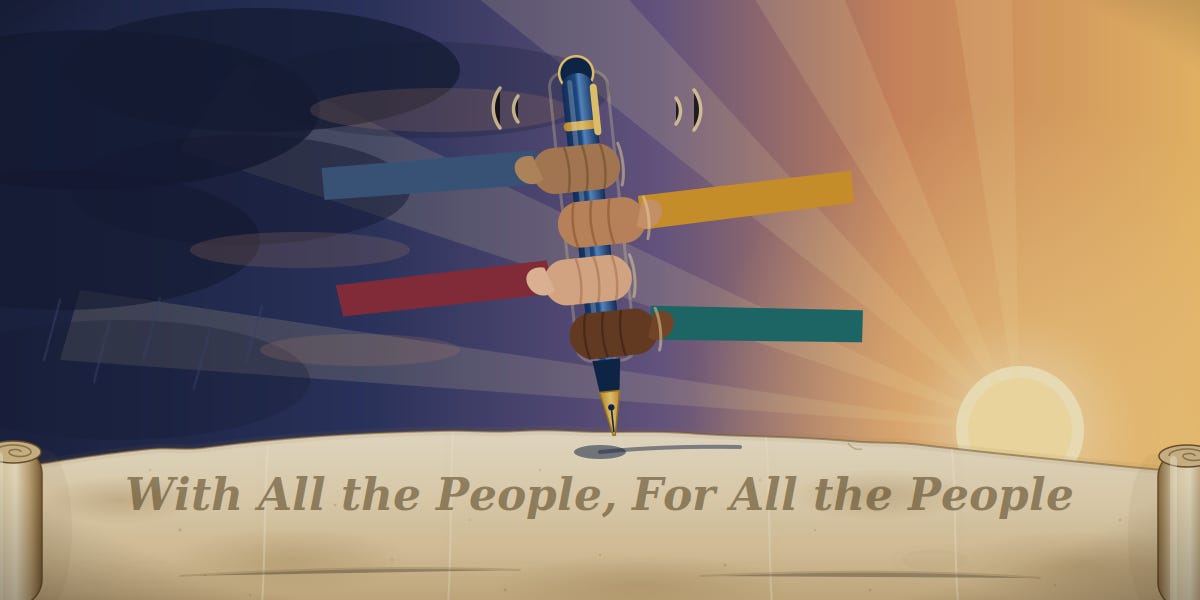
I am not asking you to feel optimistic. I am asking you to face the truth — both faces of it — and then to act like someone who has faced it. The window is coming. The playbook is loaded. And the architecture of the people’s answer is rising to meet it. We the People hold the pen, and the work of this hour is making sure enough of us are holding it together when the moment arrives.
If you or your organization wants a seat at this table — deliberation partnerships, state campaigns, the national funding case, or the cohesion conversation itself — come find us at renewoursystem.com. The door is open. The timeline is real. The Founding is accelerating.
Renewing American democracy so that we can all thrive together. All people. All places. Thriving together. No exceptions.
Key Links & Resources
RAD Strategy & Renew to Thrive
Renew American Democracy — The Plan — three-year action architecture (2026–2029), five pillars, three emergency scenarios
Democracy Renewal Group — U.S. Democracy Assessment — the diagnostic underpinning the RAD strategy
Nationwide Deliberation Campaign
NDC public page — introduction and participation pathway
Systems Transformation Pathways
VthePeople — October 2–3, 2026 Harvard Law School conference on Article V, convening supporters and skeptics
Making an Article V Convention Safe for Democracy — the safeguards and 13-state strategy
The Fulcrum — Article V convention — additional public discussion of the convention pathway
Partners in Democracy — state democracy renovation, the Common Purpose Council, ecosystem mapping and the democracy scorecard
Issue One and the Issue One Reform Agenda — the American Anti-Corruption Act, Checks and Balances Act, and Information for America Act
People’s Bill of Rights 250 — national deliberation infrastructure asking Americans fundamental questions about freedom, power and responsibility
Independent National Convention — September 23–25, 2026; the largest gathering of American independents
Deliberative Democracy Practice
The Forum — state programs in Nevada, New Hampshire and South Carolina; four-phase model with a 70%+ assembly consensus threshold
U.S. Civic Assemblies Tracker (CADA) — tracking civic-assembly activity nationally
Hope for Democracy — catalyzing state citizens’ assemblies in 21 states with a referendum mechanism
Courageous Colorado — state civic initiative using deliberative technologies
The Deliberative Wave Reaches American Shores — on the spread of citizens’ assemblies in the U.S.
The Great American Deliberation — the deliberative campaign vision behind the People’s Proposal
Framing, Systems & Strategy
The Path to a Fourth Founding — connecting the Fourth Founding frame to current strategy
American Academy of Arts and Sciences — Our Common Purpose — the source of the “fourth founding” language and a six-strategy renewal agenda
Overcoming Fragmentation and Navigating Uncertainty — field fragmentation, adaptive strategy and readiness
A Theory of Change Is Not a Theory of Power — sharpening the relationship among change, power, strategy and implementation
Citizen v2.1 Initiative — civic-renewal resource on the social contract
Thriving Together & Vital Conditions
The Rippel Foundation — Movement to Thrive Together — civic capacity and the conditions for community flourishing
Vital Conditions Data — community-level data for multi-solver, kitchen-table deliberation
Storytelling & Public Diffusion
Goodbye Politicians — documentary making citizens’ assemblies accessible to general audiences
Dr. Paul Zeitz, is a preventive medicine physician, epidemiologist, ordained Song of Songs Rabbi, and founder of #unifyUSA and co-coordinator of Renew American Democracy (RAD) enterprise. He is the author of Hit Refresh on the U.S. Constitution and Revolutionary Optimism: Seven Steps for Living as a Love-Centered Activist. He delivered the TEDxPrinceton talk “Peacecrafting: From Conflict to Collaboration” in February 2026.
This is quite a bold and visionary article. I would love your views on these Ten Points of Pathways for Decentralization here, please comment:
https://alannahartzok.substack.com/p/pathways-to-decentralization
Continue the conversation.
Join Us: bit.ly/R2Tjoin
Renew to Thrive Synergy Huddle
Noon–12:00 PM ET / 9:00 AM–11:00 AM PT
First Thursday, Monthly
https://www.google.com/url?q=https://us02web.zoom.us/meeting/register/pA-ZLOTTRDGjQJ4IeNDaOA&sa=D&source=calendar&usd=2&usg=AOvVaw2j_yW8hh5cZBSlXhvd9SHV