

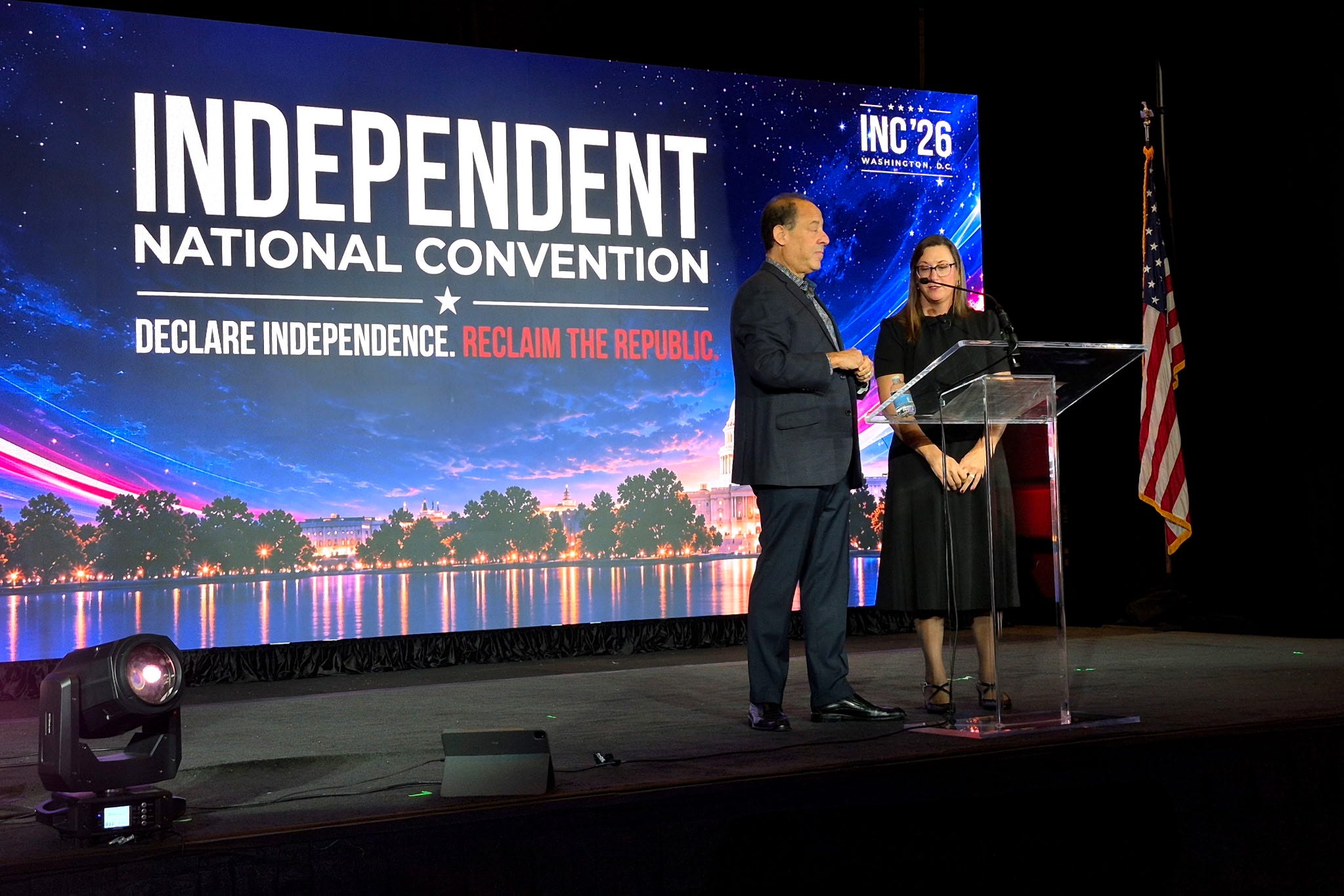
This morning we stood together on the main stage of the Independent National Convention in Washington, DC. One of us (Heather) helps give each individual in the independent movement voice and leadership. The other (Paul) represents Renew American Democracy, catalyzing as cross-ideological supermajority of the broad society to transform our systems.
We met only a few months ago, in Philadelphia at the Braver Angels National Convention. We each committed to courageous citizenship that sparked our catalytic action as we now stand side by side—is the whole point. We are the embodiment of an intention: to weave the movement of independent voices together with the 13,000 national organizations working as a “movement of movements” to renew our social, economic, and political systems.
Political movements never rise on their own. They draw strength from the social and cultural currents around them, the way a hurricane draws its power from warm water. Right now, both currents are warming at once. The independent movement is surging, and so is the civic movement for democratic and economic renewal.
There is an old saying worth holding onto as you read: nothing is more powerful than an idea whose time has come. We believe the Independent Fulcrum Caucus (IFC) is exactly that idea, and this piece lays out why.
Living Through the Fourth Founding
Everywhere we go across the civic ecosystem, we hear the same recognition: this political crisis is more than something to survive. Many of us have come to see that we are living through the Fourth Founding of our country.
The first founding birthed a revolutionary experiment in self-government, even as “We the People” left most of the people out. The second founding followed the Civil War, when the 13th, 14th, and 15th Amendments wrote the abolition of slavery, equal protection, and voting rights into the Constitution itself, after generations of abolitionist organizing. The third founding unfolded across the 20th century: women won the vote in 1920 after seventy years of movement-building, and the civil rights movement secured landmark legislative victories in the 1960s.
Every founding expanded who counts. Every founding began in rooms full of ordinary people who refused to accept that the system could not change.
The Fourth Founding is a moment of possibility, when we, the people, can transform our social, economic, and political systems to meet the needs of all the people. A government with all the people and for all the people. At its heart is something simple: harnessing the collective wisdom of Americans through deliberative democracy and Citizens’ Assemblies, where everyone gets a real say, everyone’s say counts equally, and people listen and deliberate with dignity.
That vision has to include independents. Heather is a lifelong independent. In state after state, independents like her are blocked from voting in taxpayer-funded primary elections. Paul, also a lifelong independent, has been locked out of primaries for the past 26 years in his home state of Maryland. The Fourth Founding should transform our voting system and guarantee the rights of every citizen, including full voting rights for every independent.
From an Idea to a Movement
Over the course of this convention, attendees heard the origin story of the Fulcrum Caucus from Greg Orman and a bold vision for it from Christopher Life, United Independents. Our job this morning was the pivot: moving from an idea whose time has come to a movement that delivers.
The Independent Fulcrum Caucus is the fastest path we have to renew Congress and break the grip of polarization. Independents elected to the IFC stand with one another instead of caucusing with Democrats or Republicans, organizing around a shared governing agenda rooted in the Independent Veterans’ 13 Shared Governing Objectives.
In January 2027, the 120th Congress convenes, and it is likely to be closely divided. In a Congress that close, a handful of independents, accountable to the people they represent instead of party bosses, can deny either party a governing majority. They become the fulcrum: the members nobody can pass anything without.
This is no distant dream. In three Senate races, Democrats cleared the field so that independent candidates could go head-to-head against the incumbent: Dan Osborn in Nebraska, Todd Achilles in Idaho, and Brian Bengs in South Dakota. These are viable, winnable races. Across the country, the quality and quantity of independent candidates running for Congress is unprecedented. In addition, Independents Win has identified three viable Independents running for the House of Representatives: Kevin Kiley, CA-06, Bill Hill, AK-01, and Sarah Zabel, ID-01.
Once the first independents are seated, principled members of both parties will have a home outside the two-party caucuses. As they join, the IFC becomes truly cross-partisan. The Fulcrum Caucus can hold cross-ideological perspectives and still act together.
The Veteran Slate: A National Opportunity
Look closely at the most prominent independents running for the U.S. Senate this year and a pattern jumps out: they are veterans. Championed by Independent Veterans of America, six veterans form the heart of the independent Senate slate:
Dan Osborn, Nebraska (Navy and Army)
Seth Bodnar, Montana (Army)
Todd Achilles, Idaho (Army)
Brian Bengs, South Dakota (Navy and Air Force)
Ty Pinkins, Mississippi (Army)
Bob Chew, Colorado (Navy)
These candidates answered the call to serve once, and they are answering it again, this time here at home, to help heal our broken politics. At a moment when nearly every institution has lost public trust, military service remains one of the few identities that still commands deep respect across party lines. Veterans know how to put mission before faction, and they know that no one accomplishes anything alone. That is precisely the spirit an Independent Fulcrum Caucus needs.
This slate is also a rare national organizing opportunity. You do not have to live in Nebraska, Montana, Idaho, South Dakota, Mississippi, or Colorado to help elect these candidates. Americans in every state can donate, make calls, write postcards, share their stories, and recruit friends and family to the cause. Veterans and military families everywhere can lend their voices to fellow service members who are running to put country over party. If even a handful of these six win in November, the Fulcrum Caucus in the Senate moves from vision to reality in January 2027.
Join the national mobilization behind the veteran slate at independentswin.com.
Listening First: What 101 Americans Told Us
We wanted to model the very behavior we are asking of Congress. If we expect our representatives to listen to the people, we have to start by listening ourselves.
So, in recognition of Constitution Day, Independent Vo!ce and Renew American Democracy partnered with AllSides to host a National Roundtable on Renewing Congress Through an Independent Fulcrum Caucus, held September 14–17, 2026. Over four days, 101 Americans from every region of the country, spanning left, right, center, and beyond, sat down in small, structured conversations with people who see the world differently than they do.
The AllSides “Renewing Congress” Roundtable format is built for exactly this: real dialogue across difference, with equal time and equal dignity for every voice. Participants explored what it would mean for a small bloc of independents to hold the balance of power in the 120th Congress, what they would want such a caucus to stand for, and what would earn their trust.
The full synthesis report will be released in early October. Here is a first look at what the post-Roundtable survey revealed.
The Results at a Glance
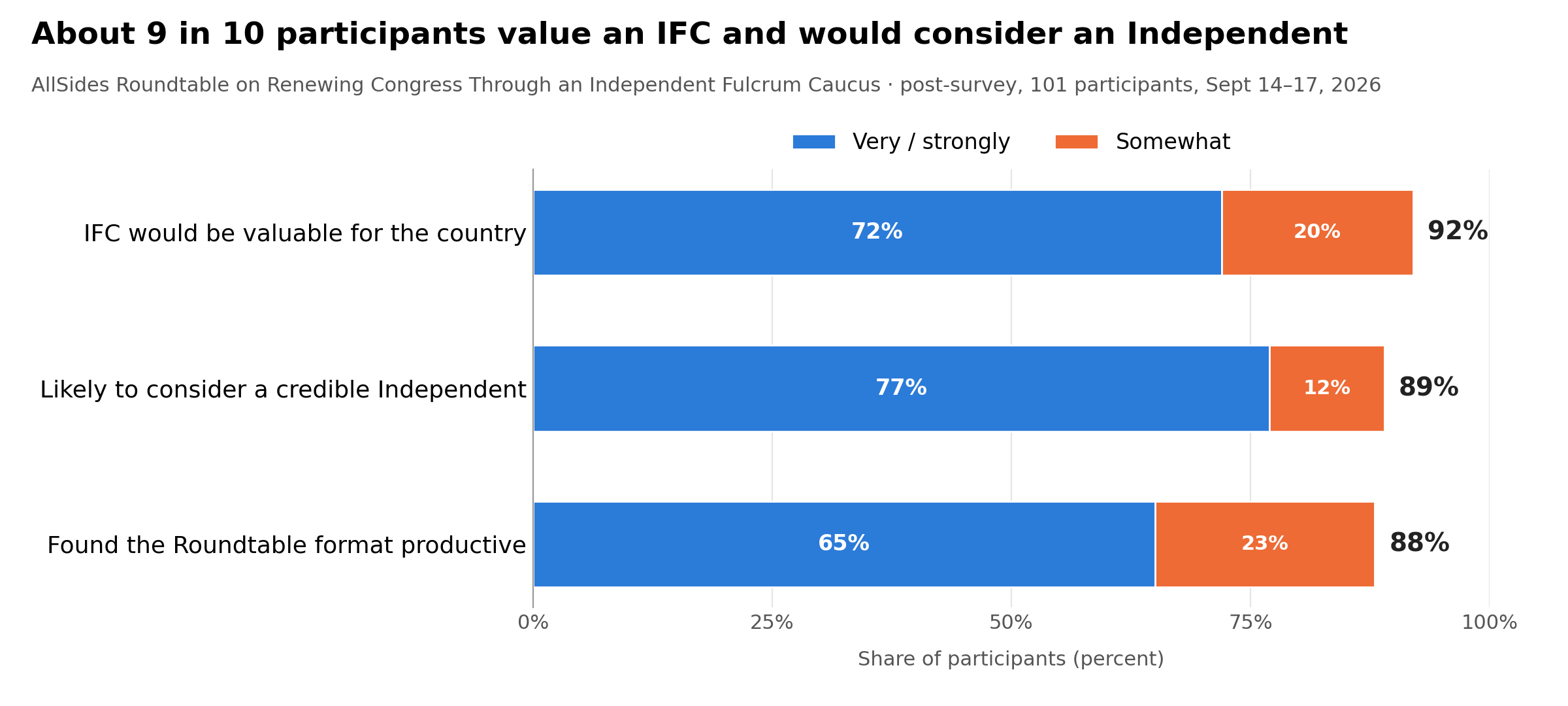
The intensity matters as much as the totals. Nearly three in four participants (72%) called an Independent Fulcrum Caucus very valuable, and more than three in four (77%) said they would be very likely to consider voting for a credible Independent for Congress.
Two more findings stand out. First, 62% had already heard of the IFC before the Roundtable, a sign that the idea is spreading on its own momentum. Second, the conversation itself moved people: 46% came away more favorable toward the IFC, 45% held steady, and only 3% grew less favorable. For every participant who cooled on the idea, roughly fifteen warmed to it.
Who Came to the Table
The Roundtable was deliberately cross-ideological. Among participants who shared their political leaning, the largest group, 39%, identified as Center. A third (33%) leaned left or identified as Left, 12% leaned right or identified as Right, and 15% described themselves in some other way, a telling number in its own right, since millions of Americans simply do not fit the left-right spectrum at all.
Participants came from every corner of the country: 42% from the South, 20% from the Northeast, 18% from the Midwest, and 18% from the Southwest. The group skewed toward experience: 79% were 40 or older, with the largest single cohort (31%) in their sixties, while 21% were under 40. Men made up 59% of participants, women 33%, and 8% identified otherwise or preferred not to say.
We want to be transparent about what this sample is and is not. It is a deliberative gathering of engaged citizens, not a random national poll. Right-leaning Americans, women, and younger voters were underrepresented, and closing those gaps is a priority for the Roundtables ahead. Even so, the pattern is striking: a plurality from the political center, joined by people from across the spectrum, arrived at the same conclusion.
Why Now: What the Data Tells Us
Taken together, the Roundtable findings point to five reasons the Independent Fulcrum Caucus is an idea whose time has come.
1. The people are already there. With 92% seeing value in an IFC and 89% open to voting for a credible Independent for Congress, the demand is not something we have to manufacture. Voters are ahead of the two parties. What has been missing is a credible vehicle, and the IFC offers one.
2. The idea is spreading on its own. Nearly two in three participants had heard of the Fulcrum Caucus before they joined the conversation. An idea that travels by word of mouth, before any major media campaign, is an idea with its own momentum.
3. Deliberation builds support. When Americans talk it through together, support grows. Nearly half became more favorable, and almost no one became less so. That is powerful evidence for the core premise of the Fourth Founding: when people deliberate with dignity, they find common ground. And 88% found the format itself productive, a strong signal that Americans are hungry for this kind of conversation.
4. The political center is the largest bloc in the room. When the 39% who identified as Center are combined with the 15% who reject the left-right labels altogether, a majority of participants stood outside the traditional two-party frame. Independents are no longer the margins of American politics. They are its center of gravity.
5. The window is open right now. A closely divided 120th Congress, viable independent Senate candidates in head-to-head races, an unprecedented field of House candidates, and independent candidates signing a shared Declaration at this convention to stand together in a Fulcrum Caucus: the conditions line up in 2026 in a way they may not again for a generation.
The Hard Question We Heard
The Roundtables were full of energy. They were also full of honest skepticism, and we want to name it. The toughest question participants raised was this: Will independents actually stand together? Why should I trust them? And how can we hold an Independent Caucus accountable to uphold civic integrity?
That is a fair question, and voters deserve a real answer. Part of that answer is already unfolding. At this convention, independent candidates came to listen to the people they hope to represent: independent voters and the organizations working to renew and strengthen our democracy. Many are committing to listen to and serve their constituents, to fulfill the promise of the Constitution, and to stand with fellow independents in an Independent Fulcrum Caucus.
The rest of the answer is what we build together from here: a shared governing agenda, transparent commitments, and ongoing deliberation between independent members of Congress and the citizens who elect them. Trust is earned through accountability, and accountability grows through continued listening.
Imagine It With Us
January 2027. The 120th Congress convenes, and a small bloc of Fulcrum independents holds the balance of power. They use it to demand real hearings, real debate, and real deliberation, and to move legislation that serves the country instead of the party.
2028. The caucus grows. Principled leaders from both parties begin to stand with it, because the country finally outweighs the party.
And beyond. We see the Independent Fulcrum Caucus as the first step toward a Government of National Unity: a governing coalition, anchored by independents and joined by principled members of both parties, committed to establishing a process through which the American people themselves co-shape a constitutional transformation built to serve us for the next 100 years.
That process must be deliberative at its core. We are advocating for the use of deliberative technologies, including Citizens’ Assemblies and large-scale platforms like the AllSides Roundtables, to catalyze the founding of a new form of self-governance: with all the people, for all the people. Through it, we can peacefully co-shape the transformation of our social, economic, and political systems so that all Americans can live and flourish together in peace.
The 101 Americans who joined us at the Roundtable offered a small preview of what that looks like: people who disagree, sitting together with dignity, and finding their way toward a shared future. Like every founding before it, this one will be built over years. It starts now.
Your Invitation
Let’s mobilize the 100 million Independents across our nation, together with millions of disenfranchised Democrats, Republicans, and MAGA supporters who feel that neither party is truly serving them. We can work together peacefully, bridge our divides, and unleash our unbridled American imagination, our ingenuity, and our innovative, love-centered minds to build a government that works for all of us.
The Independent Fulcrum Caucus will not build itself. It needs partners, funders, organizers, and, yes, candidates. There is a role for you.
Here is how to get involved right now. Watch for the full AllSides Roundtable synthesis report in early October, and join us for our online press conference on October 8, 2026. Learn more about the Roundtables at allsides.com/fulcrum. Connect with Renew American Democracy and Independent Vo!ce to help build the IFC’s durability for the long haul. And share this post with the independents, the frustrated partisans, and the hopeful skeptics in your life.
Two things you can do today:
Spread the word about the Independent Fulcrum Caucus. Share this post, talk about the IFC with your friends, family, coworkers, and neighbors, and bring the idea into every conversation where people say the system is broken.
Donate to Independents Win! Your contribution fuels the national mobilization behind the veteran slate of independent Senate candidates. Give today at independentswin.com.
Stay tuned for the release of the full report os the recent allside.com Roundtable in early October: Renewing Congress Through the Independent Fulcrum Caucus.
Declare independence from the two-party stranglehold on our government and our lives. Reclaim the Republic.
Because nothing, nothing, is more powerful than an idea whose time has come.
Dr. Paul Zeitz, is a preventive medicine physician, epidemiologist, ordained Song of Songs Rabbi, and founder of #unifyUSA and co-coordinator of Renew American Democracy (RAD) enterprise. He is the author of Hit Refresh on the U.S. Constitution and Revolutionary Optimism: Seven Steps for Living as a Love-Centered Activist. He delivered the TEDxPrinceton talk “Peacecrafting: From Conflict to Collaboration” in February 2026.
Brilliant post and update.
I started writing about an independent fulcrum caucus in 2022. Those writings became the Common Sense Papers No. 1 to No. '76. I was not able to attend INC this year. A lot has happened to reach this point. A ton of infrastructure is still missing. I don't know how each independent race for U.S. Senate/House is going to shake out, but I am confident that more "shots on goal" will accelerate the capacity to ultimately hit the target.
Paul, I appreciate you. I appreciate the work you are doing. I appreciate the values that motivate your desire to champion healthy political reform. Keep going! I am with you!!!